Showing posts with label WW2 Naval. Show all posts

Thursday, July 15, 2021

AHPC Crusier Trieste


Second last day of the challenge and second last post fro me, the Italian cruiser Trieste from GHQ in 1/2400.  I had the model primed in one of the first batches of work for this year's challenge but she's been kicking around the work table semi finished since December. 


Trieste and her sisters were armed with 8" guns but only lightly armoured.  Her sparse superstructure are typical of e 1920s era designs,  The float plane on the foc'sle seems precariously perched and required that she steam into the wind to launch it.


I've painted her in a camouflage scheme that she wore in 1942 even though it comes from a later date than the era that I'm focusing on. She had a busy war attacking and escorting convoys.  She was torpedoed and damaged by HMS/M Utmost in late 1941 and sunk by US bombers in port in 1943.


There's some interesting history in the naming of Italian 8" gunned cruisers of this era, all seven were na med for former Habsburg territories taken over by Italy after WW1.  The three name sake territories for the  Trento class (Trento, Trieste and half sister Bolzano) all remain Italian.  But three of the four Zara class (Zara, Pola and Fiume) were named for territories that are now Croatian (and renamed) with Gorizia being the sole exception.   None of the seven ships survived the war.


As Trieste sails off so do my entries in the Naval Side Duel.  That's another hull and another two points and a tip of my hat to Adam and the other participants in that challenge.

Tuesday, June 15, 2021

Yet More Allied Destroyers


Following on from previous posts I think I'm reaching the end of the destroyers in house.  These are 5 allied N class destroyers plus another radar blip dummy counter to represent an unknown sighting.  The models are all CinC, 5 are J/K/N class and the sixth is a spare "L" AA type.  CinC sells these in packs of 5, but there were only 4 in this particular configuration so spare one became a dummy counter.


Given the mess ups over the L/ M class, the next batch of Royal Navy destroyers went back to the successful J/ K class design.  They did manage to fix he one odd feature so that the rear "X" mount now was able to fire astern.   None of these ships served in the Royal Navy during WW2 although a couple did RN service after the war.  Five were manned by the RAN, two by the Dutch Navy and one by the exiled Polish Navy.


HMAS Napier, Nestor, Nizam and Norman split their service between the Med and the Indian Ocean before heading to the Far East in 1944.  I've tried my hand at period camo again, including a couple with a tan base which was effective against the North African coast. Nestor was sunk off Crete in 1942 and was the only RAN ship never to serve in Australian Waters.  HMAS Nizam was named for the Last Nizam of Hyderabad  who paid for her.  That's how you roll when you're the richest man in the world.  

ORP Piorun served both in the Atlantic and the Med.  She was one of the destroyers who engaged the Bismarck at night prior to the Bismarcks' final battle.  She is said to have sent the signal "I am a Pole" by signal lamp prior to engaging.

That is 6 hulls of 1/2400 scale ships for another 12 points, which also count in my Naval Side Duel.  There are more ships to come but I'll have to join Mr Peabody in the Wayback machine to go back a few centuries.

-------

The Cap'n likes these, oh yes he does! In fact, there is a local memorial service for NIZAM in a few weeks time which I am attending. In her spirit I grant a bonus points for each RAN vessel you have delivered here today - 16 points for you Peter!

Cap'n Wednesday

Monday, June 14, 2021

AHPC L Class Destroyers


Another four Royal Navy destroyers from my WW2 med theatre project, these representing the four L class destroyers armed with 4" AA guns as main armament.  All four ships served in the Med and were lost there between January and May 1942.  HMS Lance and HMS Lively were part of force K with HMS Aurora and HMS Penelope, which had some notable successes in its brief history.


The design history of the L/M class destroyers had a number of bumps that were unfortunately matched by my attempt to proceed models for the ships.  Fresh not the heels of the highly successful J/K class of destroyers, the naval design team decided to do what all designers do and improve a good thing by changing to a new main armament.  The new 4.7" gun fired a bigger shell, had some high angle capability and had an improved gun house.  But it never worked as an effective AA gun and and the director was overweight giving structural issues.  Simulatenoulsy the RN had an internal bun fight over the best light AA guns for destroyers, and the class was initially designed without any light AA while this was sorted out.  As a result four of the "L" class were given 8 4" AA guns in stead of the 6 4.7" of the other 12 L&M classes. 

HMSs Lively, Lance, Legion and Gurkha.  I need to redo the label on HMS Legion as it badly smudged.

So onto the model issues.  GHQ does not do either an L or M class destroyer but CinC does three different ones!  One is clearly an M class with the 4.7" mounts - these were big enough that the Italians thought the ships were cruisers on first meeting- but there are two labeled L class AA.  I ordered a pack of 5 based on what I could see on the website  and had these prepped and primed for the start of the challenge.  However, when I opened Mal Wright's excellent book on Naval Camouflage I noted that the rear guns mounts on the models didn't match the pictures in the book.  This likely wouldn't bother anyone else but having researched and ordered models to fit particular ships it bothered me.  So I went bak to the CinC webstore and ordered the other pack of L class AA destroyers which do look like the pictures i the book and those are what I've shown above.  I can't figure out what the other casting is supposed to represent but it sure as heck ain't an L class destroyer.  These casts became some of my greyscale unidentified sightings along with the extra correctly modelled L class, since CinC sells these in a pack of 5 and there were only 4 ships.


Challengers who paid attention while watching Sesame Street will note that Gurkha does not start with an L.  The ships was originally to be named HMS Larne but this was changed in honour of the tribal class destroyer lost in 1941.  The Gurkha regiments did a crowd fund to pay for the ship and command was given to the brother of an officer in the Gurkhas.

Excuse the ramblings, but to sum up that is 8 points for 4 hulls in 1/2400 which also count towards my Naval Side duel efforts.


Saturday, June 12, 2021

AHPC Freccia Class Destroyers

AdamC noted that my shipyards seemed quiet of late, but there has been some work going on.  Here are four more WW2 destroyers in 1/2400 scale.  All  models are CinC.


The three ships with the candy stripe foredecks are Italian Freccia class destroyers.  There were four of this class and four more in the similar Folgore class plus modified ships sold for export to Greece and Turkey.  The Italian ships fought hard and all of them were lost during the war.  The stripes were for aircraft recognition, added after the Regia Aeronautica bombed the Regia Marina early in the war.


The final ship is another Paynes' Greyscale unidentified bogey for for of war purposes.  She is sold by CinC as a British L class destroyer (but isn't... that story with my next post).


That is 4 hulls at 2 points each for a grand total of 8 points.  These points count against my total in the Naval Side duel, but I'm long since left in the other's wake on that front.

Thursday, May 13, 2021

AHPC WW2 Italian Destroyers


It's been a week since my last post and all I've got to show for myself is these four little ships worth a whopping 8 points.   These are 4 1/2400 scale Italian destroyers and torpedo boats for my WW2 naval project.  The original plan here was to model all of the ships that took part in the actions over a 6 month period from destroyers up.  We'll see how far I get with this plan but at least I'm getting a good variety of escort vessels for a decent campaign.


Closest to the camera are two GHQ models of the Soldati class Aviere (aviator) and the Poeti class Alfredo Oriani.  Both models are sold as Soldati class but the Soldati were only slightly different from the preceding Poeti class.  Leave it to the Italians to name one class of ships after poets and then name the lead ship of the next class after the Blackshirts!  Both of these ships were heavily engaged in the convoy battles.


Now we have the Spica class torpedo boats (or destroyer escorts) Aretusa and Cigno.  These are CinC models.  With both navies mining classical mythology for ship names its not surprising that there could be both an Aretusa and HMS Arethusa on table.  At least it's not Trafalgar with two Neptunes plus a Neptuno!  


So that is 4 hulls at 2 points each for a grand total of 8 points for my overall totals and my Naval Side Duel total.  I think I need another 25 hulls or so to catch Adam assuming he stands still for a while.  Don't hold your breath on that happening.

Wednesday, May 12, 2021

AHPC WW2 K Class Destroyers


On my dungeon crawl I used two Lumberjills to transport me back to the Aquifer so that I could take the water route to level 2.  I'm not sure if it's required but here's a naval themed post to mark my second trip to the Aquifer.  I have 4 1/2400 models for my ongoing WW2 Naval project - three British K class destroyers and another dummy radar blip in greyscale.  The K class models are GHQ and the other is by CinC.


Group Sot.  Still working out how to use my lightbox so not the best photo.


HMS Kelvin, Kimberley and Kipling (the K class had the most Victorian Imperial names possible)were all heavily engaged in the Med all served in the Med.  Kipling was sunk by the Luftwaffe off Mersa Matruh in May 1942 but the other two were the sole survivors (of a class of 8) on VJ Day.  I picked up a copy of Mal Wright's book on WW2 British Destroyer Camouflage and had some fun putting some of the patterns on 1/2400 models. 

I couldn't find a mid war pattern for HMS Kelvin so used a typical Med pattern based on that worn by HMS Javelin.  These close ups show the fine detail on these 1/2400 scale models, which come up nicely with some washes and dry brushing.

HMS Kimberley sports a 1940 era pattern.  Mal notes that this was unofficial and created by the crew using what ever paints were available in the lockers.

HMS Kipling wears a 1942 Admiralty scheme with a typical mix of colours.

CinC sold this as a L class AA destroyer which it most certainly isn't.  So it's become another  radar blip.

As I get ready to post I've noted that I need to go back and add Pennant numbers on the hulls.  (G37 for Kelvin, G50 for Kimberley and G91 for Kipling).  In past posts people seem to like my basing so I thought I'd share my recipe.  I should note that it carries by batch of ships and also I use different base colours for different projects (i.e. a much greener tint for my Dutch Wars ships).
  1. I base the ships prior to priming on 2mm pdf  60mm by 20mm in this case.  The corners are rounded for my own protection.
  2. A base coat of ultramarine blue.  I think that the Med needs bright Azure tones even if it could often be an ugly grey.   I try to get close to the hull edges but would rather leave an outline of primed base than paint the hull blue and have to fix it up.
  3. An overcoat of Payne's Grey thinned down so that the base coat shows through.  If one was being really correct you could paint bands of the deeper colour to indicate mid-Ocean rollers, but that's too much bother most times.
  4. Typically I do the base edges in Payne's Grey at the same time as the overcoat.
  5. Wave highlights using a mix of Payne's Grey (or ultramarine blue depending on what's on the palette) freehanded resemble bow waves, wake and Ocean waves.  Typically I'll use a mid blue mix followed by something close to white for the crests.  At this stage I try and fill in any gaps around the waterline left in step 2.
  6. Glue the label down with PVA.  Labels are banged together in word using text boxes with  pictures inserted representing the naval ensigns.
  7. Give the sea a coat of Acrylic Gloss medium to get a shine.  This can be unnerving at first as the medium goes on milky white but dries clear.

That's 4 hulls at 2 points a pop (compared to Adam's 30 points for one hull earlier today).  

Thursday, May 6, 2021

Painting Challenge WW2 Naval Ships


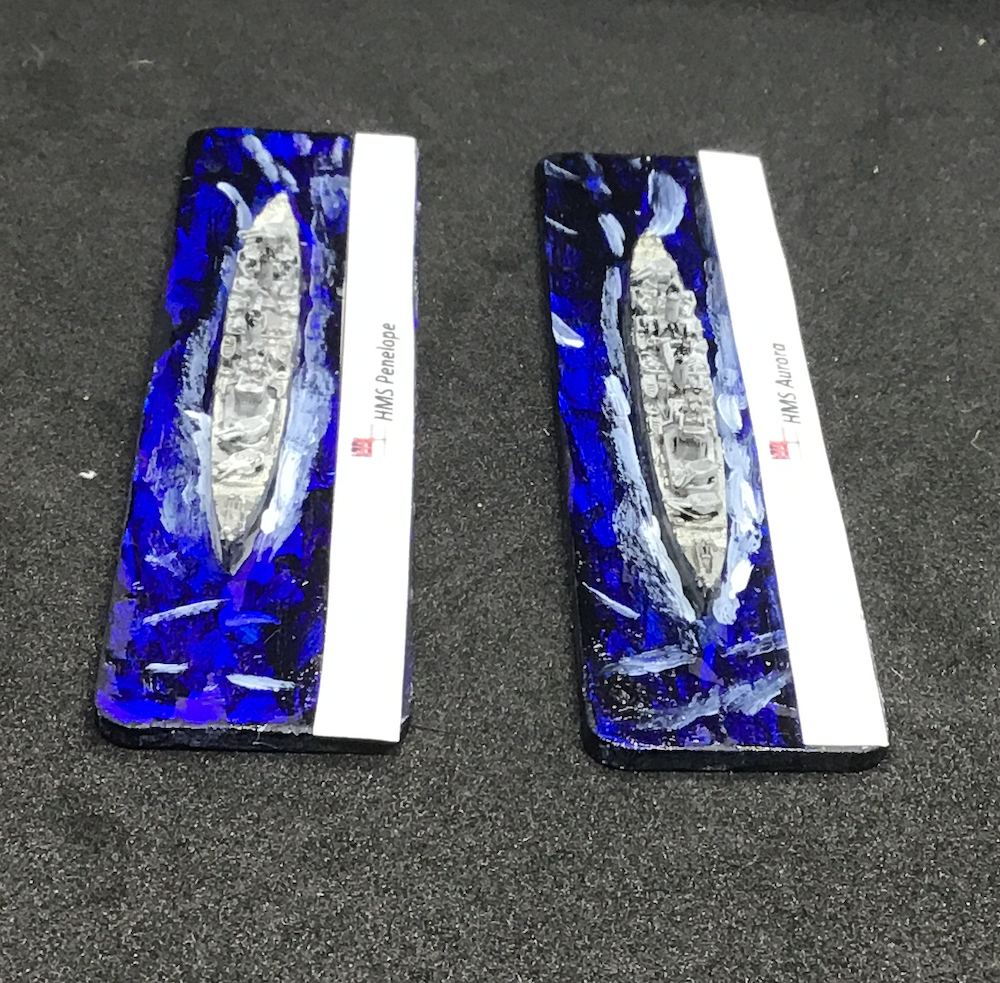
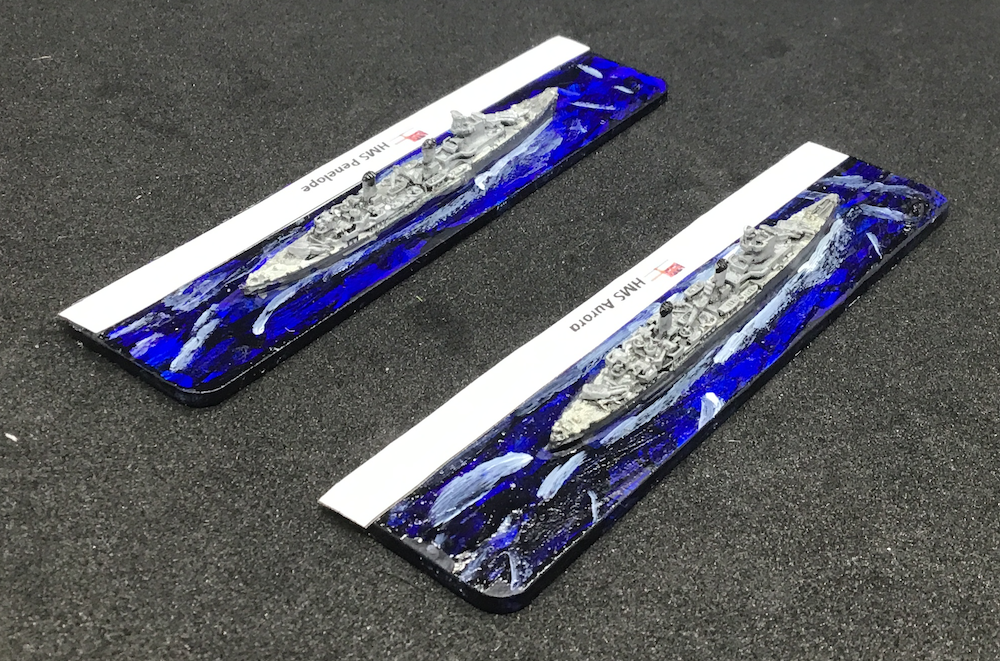
One half of Force K - HMS Aurora and HMS Penelope

This year I've been re-starting my WW2 Naval Plans that I put on the back burner about 6 years ago.  Next off of the work bench we have two British Cruisers and three Italian destroyers/torpedo boats.

By late 1941, the Royal Navy was running short on ships but had temporarily managed to get ahead in the Mediterranean.  By early 1942 the RN was thoroughly knocked for 6 and on the defensive everywhere, especially in the Med.   But for a short period, Force K composed of the small cruisers Aurora and Penelope and two destroyers ran the table against the Italians.


I've had fun researching camouflage patterns.  The cruisers of Force K used a rather natty two tone grey pattern with light upper works and dark hulls.


Inter-war naval treaties limited each Navy to a set tonnage of cruisers. For most Navies this emanate building as many big cruisers as possible within your cap, but for the RN and its Imperial responsibilities the number of cruisers was just as important.  The 4 Arethusa class cruisers were small with only room for 6 6" guns but did sterling service and were hard worked.  

HMS Aurora may have been the best shooting ship in the RN.  Penelope  was nicknamed  first HMS Pepperpot after a heavy bombing left her a lot of splinter holes, and then HMS Pocurpine after the holes were plugged with timbers that extended outside of her hull.


The cruisier models are both GHQ and I'd forgotten how fiddly these could be.

I also have three Italian escorts the Soldati class Alpino, the Freccia class Fulmine and the Spica class torpedo boat Calliope.  The first two are GHQ and the Calliope is CinC.


This ships will count towards my total in the Naval Side Duel as I inch along incrementally.  They will also give me a squirrel point in the Squirrel challenge once I amass a full 25 points for the WW2 project (currently I sit at 20 points).


Back again, Peter? So soon?

Those ships are rather spiffing. I'll go along with your suggested points (I'm sure they are based on scoring from previous Challenge years), so that's another 10 points for you.

Tamsin

Friday, April 30, 2021

Ships in Grey Scale

Next up is for a theme chamber based on painting in Greyscale...
Ships ahead - are they Ours or Theirs?

Sailing on from the aquifer, we sense shadowy shapes in the Chamber of Darkness but it's difficult to tell if they are friend or foe.

After a 6 year hiatus I have set getting my WW2 Naval project back in business as a goal for 2021.  I do my games in the Med theatre and have narrowed my focus to late 1941- early 1942 looking at historical squadrons and the actions that they fought.  Many of these actions were fought at night with identification (or lack of) playing a key role.

These four tokens were painted to represent potential sightings which have not been firmly identified.  My own experiences (Warning - Old Fart Moment Ahead) of night time Channel crossings with my dad showed me that recognizing shapes, sizes, directions and speed is very difficult.   I figured this would be a good opportunity to meet the greyscale challenge.  


The ships are 4 CinC 1:2400 scale destroyers which were deemed surplus to my needs.  There are 3 supposed British "L" class destroyers which turned out not to have the right feature plus a Spica class TB.  I will relay the full L class saga another times, but for now will note that I am odd and get persnickety abut fielding the correct destroyers.

These were quick to paint up but I am pretty pleased with the end result.

These were painted using mostly Paynes' Grey with Carbon Black shading and Titanium White mixed in to get lighter shades.   Paynes' Grey is actually a very dark blue, but I'm hoping the name will let me slide it through.  Tables include a radar blip image and Capital Greek letters for identification.  I spelled out the letter names for benefit of gamers who speak neither Greek nor Mathematics.

Points wise that 4 1/2400 ships @ 2 points plus 20 for the chamber = 28 points.  A whopping 8 of these go towards my death by a thousand paper cuts total in the Naval Side Duel.

Thursday, April 29, 2021

Initial post from the Challenge

I am going back through my post on the Challenge blog from this year.


Lupo and Cassiopia


First post from me this year and I think the first entry in the Naval Side Duel.  I have two Italian Spica Class torpedo boats (equivalent to a Destroyer Escort in USN speak) from WW2.  The models are in 1/2400 scale and are by CinC, now sold by Legions IV Hire slightly to our east in Winnipeg.  They are sailing up the Aquifer to get me not our dungeon's first level.


Lupo had the reputation of the luckiest ship in the Navy. 


A series of Naval Treaties limited nations' ship building in most categories, but placed no limits on torpedo boats under 1000 tons displacement.  The Germans built the Elbing class that gavee Allied Light Forces a headache in the Channel, the French built the almost useless Melpomene class and the Italians built these very successful and hard worked ships.  They carried three 4" guns, a light torpedo armament pus AA and ASW weapons.  They carried out the bulk of the escort work on the Convoys to North Africa.  Most importantly for the Regina Marina they were much more economical on fuel than larger ships, with oil reserves being the biggest factor restricting operations as the war dragged on.

There were 30 in the class, plus two sold to Sweden, and more in two similar classes.  Many of them put up impressive battle records. After the Italian Armistace many were taken over by the Kriegsmarine while others served with honour alongside the allies.  


These are the first pictures taken in my new light box picked up over the summer.


In the past 1/2400 scale ships have been worth 2 points a piece, meaning that I've got to put out a lot of hulls to keep pace with my opponents in the duel.  Add in the 20 points for the location and it's 24 points for the entry.


Sunday, June 21, 2020

Best Father’s Day Gift Ever

No new minis to share today, but lots of backlog to catch up on.

However, today’s topic is this fine set of young men and woman who arrived on my lawn at lunchtime today courtesy of my wonderful wife and daughter.


Wednesday, May 27, 2020

Anglo Duch Wars AAR pt 3

Situation after firing on T7.  Smoke puffs on the engaged side indicate ships that fired this turn.  Puffs on the unengaged side indicate unloaded guns from prior turns.

In turn 8, the iniative order became key due to the Fire as She Bears (FASB) rule.  The Dutch won the toss and the order of movement was as follows.

  1. The Dutch move their Flagship Zeven Provincien first.  She attempted a FASB on the English tail ender Ruby before movement.  This required a successful reload roll and then -2 penalty kn her dice, ut it was the only way she could fire before the English swept past her.    She reloads and hits Ruby 4 times, causing a crew catastrophic hit.  Zeven Provincien then moves her full distance forward.  Ruby reloads and FASB before ZP moves out of arc, scoring 1 hit.
  2. The English move their flagship Royal Charles next,  attempting a FASB on the Dutch tail-ender Noorderkwartier.  However, she fails her reload and moves her full distance without firing.  Noorderkwartier declines the possible FASB on Royal Charles.
  3. The Dutch move Speigel next (second in line behind the ZP).  She could FASB but fans her reload.  The English Monck declines the FASB on Speigel.
  4. The English move their second Royal Oak.  She reloads and FASB on Geloof before movement, scoring 1 hit hit.  Geloof declines the FASB in return.
  5.  The remaining ship follow in line ahead without attempted FASBs.
In regular fire, Geloof reloads and hits Ruby twice.  Ruby is damaged and takes a morale check which she passes.

After firing on T8.  Puffs on engaged side show firing this turn.   Royal Oak has two puffs due to her heavy guns.


Turn 9 firing was on a FASB basis.  Monck failed to reload but Noorderkwartier hit Monck once.  Ruby hit Geloof twice but took one it in return.  In the morale phases, Ruby got a "must retire" result.

On the 10th turn the fleets swept past each other without FASB and the English admiral takes stock.  With his flagship worn and firing half dice and Ruby having to retire, he opts to retire with his squadron into safer waters.  The Dutch have taken less damage but let them retire rather than risk uncharted shoals.  This also made a convenient point to call it a day and figure where I'd messed up the rules.

Historically, typically the fleets came about and made another pass of one another.  The course reversals were made from the front and took a long time.  During the interval damaged ships attempted repairs, dropped out of line and/or retired home depending on the level of damage and the will of the captain and crew.  Seamanship was generally very high on both sides but it takes a while to get a line of 30 plus ships to reverse course.  James acheived the rare feat of a course reversal from the rear at Lowestoft which was quicker but took a high level of coordination and command control.  

Tuesday, May 26, 2020

Anglo-Dutch Wars AAR pt2

The situation after 5 turns.  Dutch have won the race for the weather advantage and are upwind of the English.  Both fleets have turned to a broad reach to bring full broadsides, but no fire yet.

Turn 6 before firing.  Royal Charles and Speigel exchange fire, as do Royal Oak and Seven Provinicien.  Geloof delays her turns to fire at Royal Charles but the other ships have no target in arc.

Royal Oak and Zeven Provincien each scored multiple hits with the Dutch Flagship taking the worst damage due to the heavy English Guns.  The combined fore of two dutch ships reduced the Royal Charles to worn and scored a catestrophic hit (they scored a total of 10 hits on 13 dice!), reducing her firepower by 1/2.  Royal Charles hurt Speigel in return but not enough to reduce her to worn.

Turn 7 after movement and reloading but before firing.

Cotton puffs on the unengaged side show unloaded guns.  Royal Charles and Royal Oak have heavy guns so take at least two turns to reload.  Speigel and Geloof failed to reload, but the Dutch flagship was successful.

Turn 7 firing shown with cotton puffs on the engaged side.  Note how Geloof is out of line due to the delayed turn.  All fire is between 2-4" so at close range.

Zeven Provincien and Ruby traded fire with Ruby taking 3 hits and her opponent 2.  Both became worn as a result.  Monck opened fire at Speigel and reduced her to worn, while Noorderkwartier fired an effective broadside on Royal Charles hitting 4 times on 7 shots.

I realize in retrospect that I messed up the moment after both sides turned on turn 5.  The Dutch certainly and probably the English should have moved faster as they are broad reaching not close hauled.  Oh well rookie error on a fist time play through.

Monday, May 25, 2020

Action off the Galloper Sands 1666

It's been 6 weeks since I've posted, but I've been up to a fair amount in my own private isolation chamber!  April was filled with end of semester and exams, with Zoom lectures  taking far more time than normal.  Ditto for doing individual final exams for every student.  There has been some painting appearing on the Quaratine Challenge and I'll try to catch up on these posts in the next week or so.

This weekend I got the chance to do a solo playtest of Barry Hilton's 17th century naval rules.  I ran through 10 turns using 4 ships squadrons from my Dutch and English fleets (1/2400 scale Tumbling Dice minis)

The Dutch Zeven Provinciën (80), Speigel (70), Geloof (60), Noordeerkwartier (60)

The English Royal Charles (86), Royal Oak (80), Monck (58), Ruby (48)
The flagships had veteran crews with all other crews being veterans.  The three biggest English ships have heavy guns.

The two squadrons started on equal footing close hauled.  After three turns, the speedier Dutch are pulling ahead of the English. 

The dutch have clearly won the race and are in danger of crossing the English "T".

Turn 4:  the English have the initiative and bear off the wind to bring their broadsides to bear.

Turn 5 the Dutch turn to steer parallel but on opposite courses.  Anglo Dutch Wars battles feature repeated "passes" on opposite courses.  
I'll finish up the AAR later, but can make some initial comments on the draft rules.

  • This was a fun little game
  • They played well, were fast to pick up and things were relatively straightforward.
  • They seem to give a reasonable result of the period and ships.
  • Barry's QRS wasn't readable on my iPad but I didn't really need one!
  • I was using d6, d8, d10 and d12.  It would help greatly to have dedicated colours for each type of dice.  
  • I need to iron my sea matt!  It's exterior grade vinyl upholstery so this will take research and checking with the wife on correct techniques and iron temperatures.