Showing posts with label ghq. Show all posts

Thursday, July 15, 2021

AHPC Crusier Trieste


Second last day of the challenge and second last post fro me, the Italian cruiser Trieste from GHQ in 1/2400.  I had the model primed in one of the first batches of work for this year's challenge but she's been kicking around the work table semi finished since December. 


Trieste and her sisters were armed with 8" guns but only lightly armoured.  Her sparse superstructure are typical of e 1920s era designs,  The float plane on the foc'sle seems precariously perched and required that she steam into the wind to launch it.


I've painted her in a camouflage scheme that she wore in 1942 even though it comes from a later date than the era that I'm focusing on. She had a busy war attacking and escorting convoys.  She was torpedoed and damaged by HMS/M Utmost in late 1941 and sunk by US bombers in port in 1943.


There's some interesting history in the naming of Italian 8" gunned cruisers of this era, all seven were na med for former Habsburg territories taken over by Italy after WW1.  The three name sake territories for the  Trento class (Trento, Trieste and half sister Bolzano) all remain Italian.  But three of the four Zara class (Zara, Pola and Fiume) were named for territories that are now Croatian (and renamed) with Gorizia being the sole exception.   None of the seven ships survived the war.


As Trieste sails off so do my entries in the Naval Side Duel.  That's another hull and another two points and a tip of my hat to Adam and the other participants in that challenge.

Thursday, May 13, 2021

AHPC WW2 Italian Destroyers


It's been a week since my last post and all I've got to show for myself is these four little ships worth a whopping 8 points.   These are 4 1/2400 scale Italian destroyers and torpedo boats for my WW2 naval project.  The original plan here was to model all of the ships that took part in the actions over a 6 month period from destroyers up.  We'll see how far I get with this plan but at least I'm getting a good variety of escort vessels for a decent campaign.


Closest to the camera are two GHQ models of the Soldati class Aviere (aviator) and the Poeti class Alfredo Oriani.  Both models are sold as Soldati class but the Soldati were only slightly different from the preceding Poeti class.  Leave it to the Italians to name one class of ships after poets and then name the lead ship of the next class after the Blackshirts!  Both of these ships were heavily engaged in the convoy battles.


Now we have the Spica class torpedo boats (or destroyer escorts) Aretusa and Cigno.  These are CinC models.  With both navies mining classical mythology for ship names its not surprising that there could be both an Aretusa and HMS Arethusa on table.  At least it's not Trafalgar with two Neptunes plus a Neptuno!  


So that is 4 hulls at 2 points each for a grand total of 8 points for my overall totals and my Naval Side Duel total.  I think I need another 25 hulls or so to catch Adam assuming he stands still for a while.  Don't hold your breath on that happening.

Wednesday, May 12, 2021

AHPC WW2 K Class Destroyers


On my dungeon crawl I used two Lumberjills to transport me back to the Aquifer so that I could take the water route to level 2.  I'm not sure if it's required but here's a naval themed post to mark my second trip to the Aquifer.  I have 4 1/2400 models for my ongoing WW2 Naval project - three British K class destroyers and another dummy radar blip in greyscale.  The K class models are GHQ and the other is by CinC.


Group Sot.  Still working out how to use my lightbox so not the best photo.


HMS Kelvin, Kimberley and Kipling (the K class had the most Victorian Imperial names possible)were all heavily engaged in the Med all served in the Med.  Kipling was sunk by the Luftwaffe off Mersa Matruh in May 1942 but the other two were the sole survivors (of a class of 8) on VJ Day.  I picked up a copy of Mal Wright's book on WW2 British Destroyer Camouflage and had some fun putting some of the patterns on 1/2400 models. 

I couldn't find a mid war pattern for HMS Kelvin so used a typical Med pattern based on that worn by HMS Javelin.  These close ups show the fine detail on these 1/2400 scale models, which come up nicely with some washes and dry brushing.

HMS Kimberley sports a 1940 era pattern.  Mal notes that this was unofficial and created by the crew using what ever paints were available in the lockers.

HMS Kipling wears a 1942 Admiralty scheme with a typical mix of colours.

CinC sold this as a L class AA destroyer which it most certainly isn't.  So it's become another  radar blip.

As I get ready to post I've noted that I need to go back and add Pennant numbers on the hulls.  (G37 for Kelvin, G50 for Kimberley and G91 for Kipling).  In past posts people seem to like my basing so I thought I'd share my recipe.  I should note that it carries by batch of ships and also I use different base colours for different projects (i.e. a much greener tint for my Dutch Wars ships).
  1. I base the ships prior to priming on 2mm pdf  60mm by 20mm in this case.  The corners are rounded for my own protection.
  2. A base coat of ultramarine blue.  I think that the Med needs bright Azure tones even if it could often be an ugly grey.   I try to get close to the hull edges but would rather leave an outline of primed base than paint the hull blue and have to fix it up.
  3. An overcoat of Payne's Grey thinned down so that the base coat shows through.  If one was being really correct you could paint bands of the deeper colour to indicate mid-Ocean rollers, but that's too much bother most times.
  4. Typically I do the base edges in Payne's Grey at the same time as the overcoat.
  5. Wave highlights using a mix of Payne's Grey (or ultramarine blue depending on what's on the palette) freehanded resemble bow waves, wake and Ocean waves.  Typically I'll use a mid blue mix followed by something close to white for the crests.  At this stage I try and fill in any gaps around the waterline left in step 2.
  6. Glue the label down with PVA.  Labels are banged together in word using text boxes with  pictures inserted representing the naval ensigns.
  7. Give the sea a coat of Acrylic Gloss medium to get a shine.  This can be unnerving at first as the medium goes on milky white but dries clear.

That's 4 hulls at 2 points a pop (compared to Adam's 30 points for one hull earlier today).  

Thursday, May 6, 2021

Painting Challenge WW2 Naval Ships


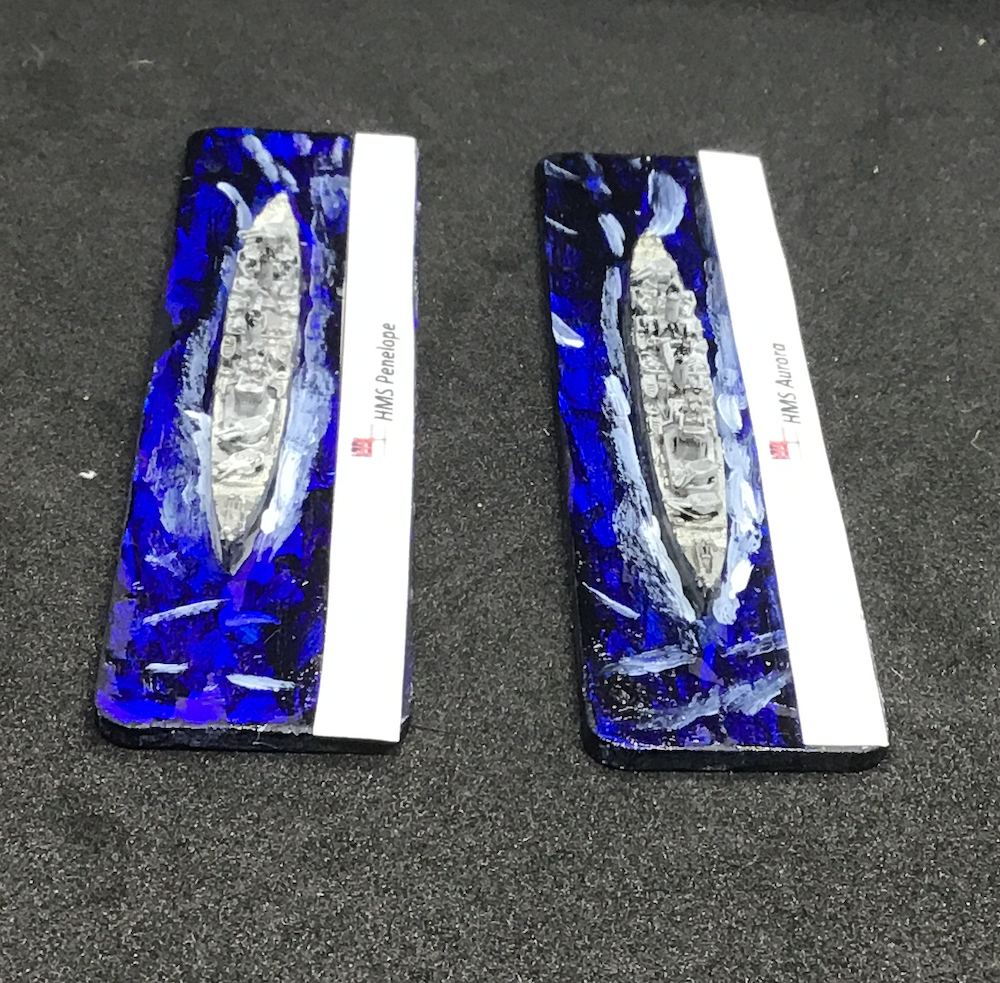
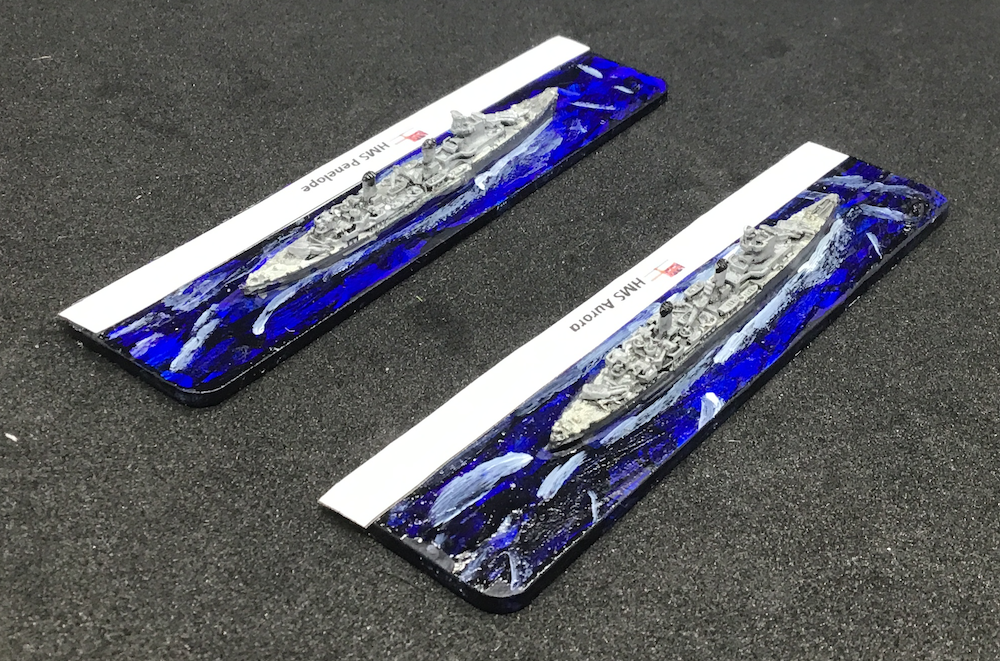
One half of Force K - HMS Aurora and HMS Penelope

This year I've been re-starting my WW2 Naval Plans that I put on the back burner about 6 years ago.  Next off of the work bench we have two British Cruisers and three Italian destroyers/torpedo boats.

By late 1941, the Royal Navy was running short on ships but had temporarily managed to get ahead in the Mediterranean.  By early 1942 the RN was thoroughly knocked for 6 and on the defensive everywhere, especially in the Med.   But for a short period, Force K composed of the small cruisers Aurora and Penelope and two destroyers ran the table against the Italians.


I've had fun researching camouflage patterns.  The cruisers of Force K used a rather natty two tone grey pattern with light upper works and dark hulls.


Inter-war naval treaties limited each Navy to a set tonnage of cruisers. For most Navies this emanate building as many big cruisers as possible within your cap, but for the RN and its Imperial responsibilities the number of cruisers was just as important.  The 4 Arethusa class cruisers were small with only room for 6 6" guns but did sterling service and were hard worked.  

HMS Aurora may have been the best shooting ship in the RN.  Penelope  was nicknamed  first HMS Pepperpot after a heavy bombing left her a lot of splinter holes, and then HMS Pocurpine after the holes were plugged with timbers that extended outside of her hull.


The cruisier models are both GHQ and I'd forgotten how fiddly these could be.

I also have three Italian escorts the Soldati class Alpino, the Freccia class Fulmine and the Spica class torpedo boat Calliope.  The first two are GHQ and the Calliope is CinC.


This ships will count towards my total in the Naval Side Duel as I inch along incrementally.  They will also give me a squirrel point in the Squirrel challenge once I amass a full 25 points for the WW2 project (currently I sit at 20 points).


Back again, Peter? So soon?

Those ships are rather spiffing. I'll go along with your suggested points (I'm sure they are based on scoring from previous Challenge years), so that's another 10 points for you.

Tamsin

Saturday, January 5, 2013

Italians At Sea


Finally we have two elements of the Regia Marina at sea, in the form of the Battleship RM Guilio Cesare and the cruiser RM Luigi Cadorna.  These two have been shadowed by two FAA Walruses (single bases) who have vectored in a flight of RAF Beaufort  torpedo bombers (reported piloted by Lts "Brutus" Smith and "Cassius" Jones).   However it appears on closer examination of the photos, that the attack below is by SM79s from the Regia Aeronautica!  Fortunately for me, if not the Italians, this was something that happened during WW2.

The ships are GHQ and the planes CAP Aero.   Curt has better photos featuring the Beaufort's over at Analogue Hobbies.


The Cesare was a WW1 design that was upgraded (ok considerably rebuilt) in the 30s.  She served at the Battle of Calabria, where she set a record of sorts thanks to the long range hit that HMS Warspite scored on her.  She also sortied numerous times to intercept British convoys, notably the First Battle of Sirte.  After the war she was transferred to the USSR and served as the Novorossiysk before being sunk by ex-German mines, Italian frogmen or random gamma rays from Mars.  She had two sister, the Leonardo Da Vinci (sunk in WW1 by unstable ammo) and the Conte di Cavour (sunk at Taranto by FAA Swordfish).

The Luigi Cadorna was part of the second group of Condottieri cruisers.  She served in the Spanish Civil War and WW2 and was present at Calabria.  Being considered too weakly protected for fleet work she was assigned a range of more dangerous tasks!  These included minelaying and serving as a fast fuel and ammo transport.  She also took part in attempts to intercept RN convoys.  She served in the RM until the early 50s.  A sister the Armando Diaz was sunk by a RN submarine on the Libyan transport run.


The Regia Aeronautica


In response to the air fleets launched from HMS Eagle, I've finished some elements from the Italian opposition.   Curt has better ones over at Analogue Hobbies.

 Here we have a formation of 6 SM79 Sparvieros accompanied by two Macchi C200 Saetta.


The SM79 was likely the best Italian aircraft of WW2.  Originally designed as a passenger aircraft, it served in the Spanish Civil War, WW2 and into the 50s.  It was used as a medium bomber and as a torpedo bomber and was especially effective as a TB.  The MC200 Saetta was a fighter than was able to take on the British Hurricanes and P40s and served ever where that the Italians did in WW2.

These are all Cap Aero 1:1250 models mounted on florists wire (visible beneath one of the SM79s in the lower photo).  While the wire looks clunky in unpainted form, I find that you can acheive a disappearing act by painting it blue to match the bases. 


In these photos we see the Regia Aeronautica in action with elements of the RN's Mediterranean fleet (both of WW1 vintage but heavily modified for WW2).   We have HMS Warspite (a ship that should need no introduction) and the C class AA cruiser HMS Cairo.  The ships are of course GHQ 1:2400 models.