Showing posts with label ancients. Show all posts

Wednesday, September 21, 2022

More Late Romans

Some pictures of another unit of Late Roman Infantry, the Auxilia Palatina Batavi Iuniores.  This unit was one of the crack regiments in the Gallic Field Army and was sent to Britain under Count Theodosius to quell the Great Conspiracy.   

I chose to model them partly because of their role in 367 CE, partly because I like the shield design, partly because they have a cool reenactment group and partly because a lot of Batavian cohort served in Brittania over the years.  I did them up in lorica hamata chainmail, but there is debate about which if any infantry units wore armour at this time.  I have decided that this was a pretty crack unit and that they'd likely acquire armour themselves if it wasn't provided for them.
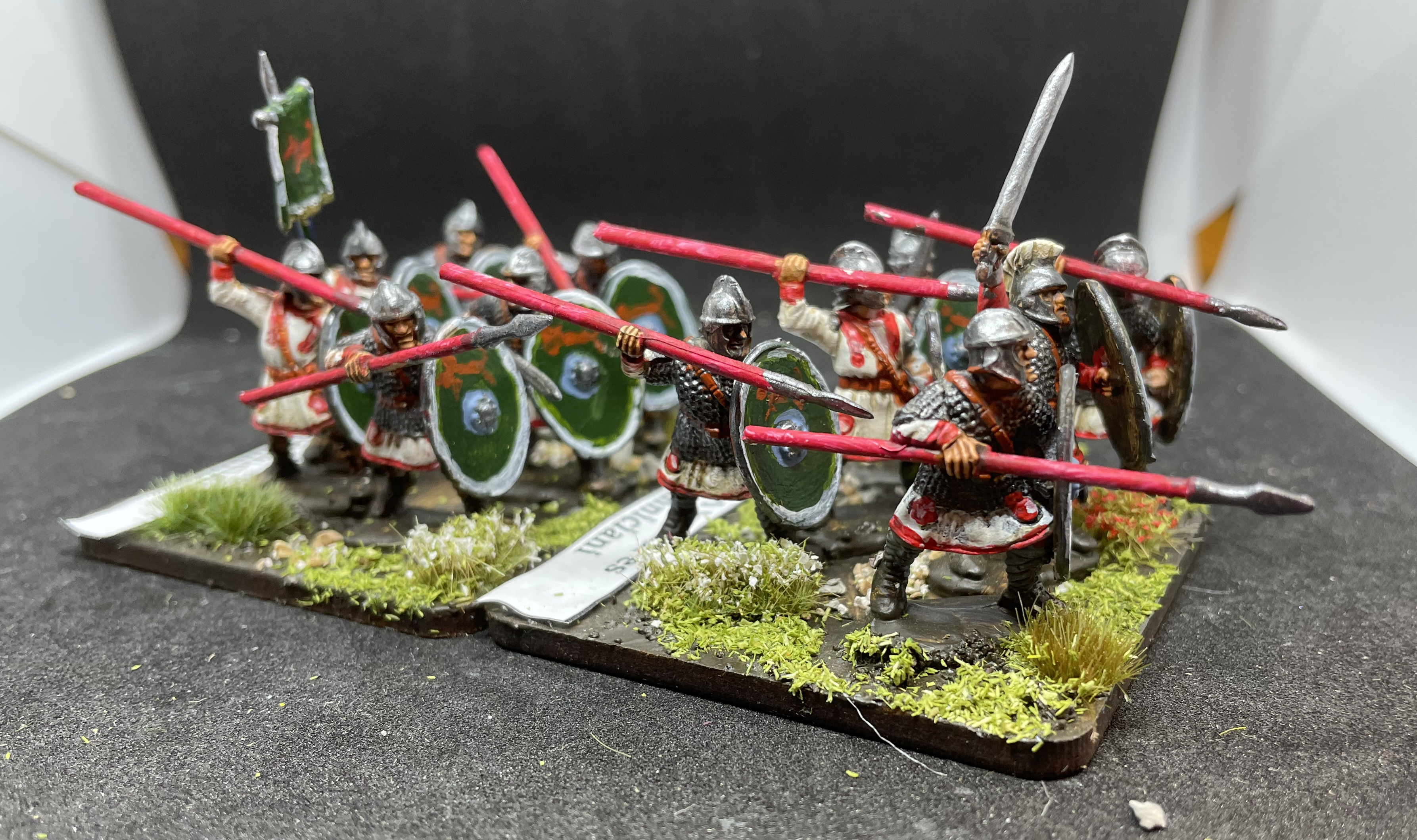


Figures are all Griping Beast plastics.  The GB Roman infantry box comes with 8 spurs each with five figures, 2 armoured with sword/spear, 2 unarmored with sword/spear and two unarmored archers.  There is also a command stand with officer and a second figure who can be a standard bearer or musician.  I think there are 8 o the armoured torsos, 2 of the unarmored spears and two command figures in the unit of 12.  Despite there only being one torso of a ranker in lorica hamata (chain mail), I found that by choosing different arms and helmets I could come up with a pretty good variety of poses.


The weapon hands in chainmail include one with sword, one with spear overhand and one with spear underhand.  There are also three variants on the shield hand and several helmets to choose from.  Mixing and matching along with slight variations in position mask the common torso on 8 of the 12 figures, although somehow I mangled to get guys in similar breeches lined up together.  I painted the spear shafts red, which looks cool and has some historical basis.  I'm not sure why I did  the vexillum shaft in blue!


I free handed the shields, so they look way better on table than they do close up  in the bright light box.  The shield in the ND is shown below, with the the helpful description that it contains a mammal!  I figured that I could paint an unspecified mammal, but it looks like a fox to me.  Certainly not a platypus, pachyderm or moose.


Wednesday, August 31, 2022

TtS Late Romans vs Scots-Irish AAR Intro The Set Up

 Last week we got my Barbarian Conspiracy Armies c367 CE on table for a battle using To The Strongest.

Curt hosted at the Clubhouse but it was my toys in use.  The Romans and some of the Irish darted from the most recent Painting Challenge, but more from a spurt of painting in late June when my wife was away and the temperatures were above 30C.  The rest of the Scots Irish were rebased from a WAB Viking Age project dating back 15 years ago.


I field two armies of equal points for a simple head to head as it was our first time with the rules, although we'd played the ECW development For King and Parliament several times.   Curt and I had a series of texts the day before that went like this.

  • If you have a rough sketch of your battlefield I can prep the table.
  • How's this
  • Sketched in less than 5 minutes over lunch.


  • That’s a good example of ‘rough’. 😊
  • Here's what he did with it


A skilled digital archivist can extract valuable info from the worst digital crap.


I assigned Stacy (or resident Mediterranean) as the Romans and Curt and Jeremy took the northern barbarians.


Barbarians at the gates


Stacy points to squirrels in the woods while I check rules.


Monday, February 9, 2015

AHPCV Curt Geld Socrates


So for this year's painting challenge, Curt has required that we paint up a 28mm entry figure of for this year's theme - Antihero.  Here's my entry figures - Socrates (the philosopher not the brilliant Brazilian footballer).   He's a metal figure by Reaper from their Chronoscope range.  I found them in December while off marking Actuarial exams in Santa Monica CA, at Aero Hobbies and Games.  It's a great little shop and I enjoyed my poke around.

So let's look at what an Antihero is, and no it is not the opposite of a hero so the semi-obvious choices of villain and heroine are out.  An Antihero is a character who is cast in the main role and sometimes acts as the villain, but who lacks heroic attributes.  Clint Eastwood's "Man With No Name" and Harry Flashman are prototypical antiheroes.


So why Socrates - in some ways I dunno really it just came to me.  But let's follow this through, is Socrates the obvious choice of hero.  Well, actually he's mostly portrayed as a old codger who asks a lot of probing questions.  Depending on who you read he could also be considered vain, curmudgeonly and having atrocious personal hygiene (think Oscar from the Odd Couple).  He doesn't fit the traditional heroic model, but I figure that he can be placed in a hero's role for two reasons.

  • He fought in the Athenian Phalanx in at least three actions Potidaea, Amphipolis and Delium.  If you're up on your Thucydides, the first was an Athenian victory but the others were big defeats.  He also apparently saved Alcibiades' life at Potidaea (OK maybe that's not a plus as an Athenian). My first ancients army was ancient Greeks and the idea of the citizen Hoplite was part of the appeal.  And yes this is the one army where citizen soldiers actually meant people you study in history class!
  • For being put on trial and executed for ...well basically for being a crotchety old fart who questioned Athenian politics and morality.  But the official charges were impiety and corrupting the youth!  According to his pupils Plato and Xenophon (yes the Anabasis guy), he did have the option to escape but refused and drank the hemlock instead.
Oh yeah, and he played a darn critical role in the history of Philosophy but I am not qualified to comment there.  Instead I refer the reader to the following education video by some prominent philosophy scholars.https://www.youtube.com/watch?v=m_WRFJwGsbY


Enough historical babble, let's deal with the figure.  The reaper figure was cleanly cast, is on the large 28mm side and was nice to paint.  I opted for basic colours without much ornamentation on the clothing, as I figured that Socrates was a pretty basic guy clothes wise, but tried to bring out details with shading, washes and highlights.  There is a lot of layered folds in the clothing, arising from a clock over top of a tunic which took some figuring out.  I was amused that I actually got to use my "Linen" colour to paint his linen tunic and the "Parchment" tube to paint the parchment scroll.


I liked the base to the figure - it's a slotta type base with a circular well that extends almost out to the edge of the base.  I filled the well with white craft glue and a mix of kitty litter, sand and model railway ballast to give some ground textures.


Friday, August 9, 2013

Cool Site on Hoplites


Last week my wife and I took a day trip to Saskatoon (2.5 hrs away) to visit Lee Valley Tools and McNally Robinson books two fine stores which we lack in Regina.  The morning was spent in Lee Valley buying watering system gadgets for our garden and drooling over wood carving tools (must resist a new expensive, messy and time consuming hobby with the danger of self injury).  Then we went to the bookstore, where I found (but did not buy) a book that hit both my wargaming and wife's sewing hobbies.  A How to on making linen body armour.  A quick google search led to this site by the prof at UWGB who co-wrote the book.

http://www.uwgb.edu/aldreteg/Linothorax.html

Also we have a how to poster  and a pattern.


So what if I get my wife who sews to make me a Linothorax?  Then I get my 18 year old (who teaches at a sports camp including archery) to shoot arrows at me while I wear said armour to test it out?  Ok maybe we'll keep this on the drawing board for a while.

Saturday, August 3, 2013

Readings and Ramblings


So the recent Hail Caesar game got me thinking more about my ancient (mid 80s) greek armies.  I could have sworn that I had a bag of left over Greeky bits (odd figures and spare Rafm spares) but I thorough scrounge through the spares and unpainted piles came up short.  So back to the drawing board on getting new figs....Maybe when the kid is off at uni I can justify a small order.

Meanwhile I been trying to figure out how to base my units for Hail Caesar.  No firm decisions on questions like 16 or 24 man units?  2 or 3 ranks deep?  Use the official HC 20mm per fig or the existing 15mm per man frontage?  Oh well.

On the plus side I've been reading!


Highly recommended - if majorly depressing.  It's always a wonder that those darned meddling Hellenes managed to buy their hatchets long enough to turf the Persians out of Greece.  Any way I learned that the Hoplite class was real read and needed to be burly to cart that panoply about.  Plus apparently olive trees are really tough to get rid of (the author tried to take out old fruit trees on his land and broke his axe).  While the big hoplite clashes were limited, there's plenty of scenario based stuff to work with.

Sunday, July 21, 2013

Hail Caesar Thoughts


OK so we've played several games of HC so far, and so it giving fun games and the basic system works well.  We've used it for encounter games using cavalry heavy armies (El Cid era) and a slug fest using infantry heavy armies (ancient Greeks).

Probably the most controversial aspect of these rules (and their sister set Black Powder) is the "all or nothing" movement which randomly leads to some troops moving lots and others staying put.  Having played through a few games I've decided that overall I like the movement/command roles much as I find them frustrating at times.  Of course I've been GMing rather than playing and I might find it more frustrating as a player.

Some thoughts on making the system work.

  1. Use a big table, specifically one with depth (or cut the movements rates to match your table depth).  That way troops have to make a few movements before coming in contact.  That gives the attackers a couple movement rolls which tends to average out the "all or nothing" rolls.  And if one division moves in contact faster than the rest of the team, well there's plenty of historical precedent for that stuff.
  2. Give each player a couple of divisions to run.  That way it's likely that every one gets to do something each turn - and if they roll really badly send them on a beer run while every one else moves.
  3. Make sure to remember the General re-roll rule (one that we tend to forget in the heat of dice rolling) or mulligan.  Once per turn the CinC can reroll a failed movement roll.
  4. Encourage the players to make division moves at least in the early stages.  It doesn't reduce the probability of a no move turn, but it does increase the expected number of units that get to move (Ok that's the actuary talking).  Plus it prevents the division getting disjointed, like the last game when one of Sylvain's pike blocks blundered through another pike unit.  Also that's how armies move - in big blocks - and the rules are flexible to allow let units reposition themselves along the way.
  5. Use the "special rules" to your benefit.  Troops in column get a free move on a failure.  Drilled and eager troops get free moves too.  Upgrading a General from an 8 to a 9 increases your movement rates and likelihoods.  Similarly remember to use the penalties for the inferior troops (militia and levy rules).   And recall that once you get within 12", you can move once on initiative.
  6. Sometimes the dice know better that you do!  It sucks but sometimes sitting tight where you are or a sudden blunder move to one flank is exactly what the doctor ordered (see the example below).
  7. Read your history - especially the primary sources- before you vent off about how "that would never happen in reality".  Two things become abundantly clear about ancient and medieval battles.   The first is that no one really knows what happened as the source descriptions are brief, often incomplete (dang those Christians who burnt the library in Alexandria), full of propaganda and focus on individual heroics rather than command control.  And really it is an educated guess as to how the battles unfolded.  You can find some very scholarly debates about the better known and documented battles (Marathon, Gaugamela, Hastings).  In a lot of cases we still can't be sure where they happened let alone how they played out.
  8. The second thing that is clear from the sources is that command control sucked back then.  Units show up (or not) in the wrong place and at the wrong time with great frequency, and yes stand about examining their own navels at the most annoying times.  So accept your bad rolls as fate, karma or the will or the gods.  Be philosophical, enjoy your beer and deal with it!


As noted above the ancient sources are notoriously scanty on details.  But later on, we get much better documentation of what happened at the command level.  Plus we get armies with better command control and better time pieces (this actually is important in figuring out what happened, and when and where it did).  And guess what we still get lots of examples of "failed command rolls".  Here's the classic case - so classic that it appears in one of the great novels.  So taken from Mr. Tolstoy we have what Christopher Duffy calls one of the most famous exchanges in military history (from the morning of Austerlitz).


"Why aren't you beginning, Michael Ilarionovich?" said the Emperor Alexander hurriedly to Kutuzov, glancing courteously at the same time at the Emperor Francis.

"I am waiting, Your Majesty," answered Kutuzov, bending forward respectfully. "Not all the columns have formed up yet, Your Majesty."

"You know, Michael Ilarionovich, we are not are not on the Empress' Field where a parade does not begin till all the troops are assembled," said the Tsar 

"That is just why I do not begin, sire," said Kutuzov in a resounding voice, apparently to preclude the possibility of not being heard, and again something in his face twitched- "That is just why I do not begin, sire, because we are not on parade and not on the Empress' Field." 

Remember this conversation the next time that you fail a command roll.  And while you are at it, recall that although the Allied plans (and Napoleon's plans to boot) Kutusov's column was to have cleared the Pratzen heights and join the attack on Napoleon's right flank.  Instead they ended up sitting tight in exactly the right place and time to meet Soult's assault.  If more columns had failed their command rolls the battle might have gone very differently!  In fact I'd suggest a read (or reread) of Duffy's Austerlitz book for any war gamer who entertains any idea of command control.  If Napoleonic armies blunder about like that, how can we possibly expect ancient and medieval armies to run by clockwork?

Sunday, July 14, 2013

Old School Figures


Well when I hauled the ancient Hellenes out of their box, it was a real walk down memory lane.  The figures (and paint jobs) are mostly 25-30 years old but mostly stood up well.  Here are a few thoughts about the old school figures - which almost all true 25mm as opposed to the 28mm guys who had taken over since that time.

Ral Partha
At one time these were the bulk of my figures.   You can still find their historicals on ebay etc, but they don't seem to be made anymore (unlike the fantasy ranges).  This is probably just as well!  There are some very good figures in the range, but there are a lot of oddities in gear, clothing, anatomy and clothing.  However, picking through the better figures they certainly fill out the numbers well.  I have strong attachments to my Rhodians (the RP Balearic slingers) which are nice figures and the first ever 25mm ancient unit I ever painted.

Rafm Multiparts
Still available (here) and many of them standing up well.  These came with separate weapons, shields and heads which mean that you can combine packs (and get separate packs of heads) to get a variety of equipment.  For a phalanx that means getting a range of helmets. The phalanx and skirmishers work really well, although for hoplites the lack of a Corinthian helmet sucks.  The cavalry figures are wimpy and static so not really worth the bother, but the heffalumps are wonderful!  These guys need some TLC as they lose not only spears and shields but also heads!

Minfigs
Ok can we get any more old school than Minifigs?  Still to be found here.  These are like Marmite (google it you non-Brits) but I like 'em.  The castings are old, lacking the details and posing found today.   But they have a real toy soldier feel and with the right paint job they look wonderful - especially in phalanxes.

Corvus
Likely the least well known figures in my collection, but I like them.  I had to google them, but found that they are still available as the Skyraider range.  These are nice figures with some useful poses and a decent range and the best cavalry figures in my army.  The major issue is that the original Corvus range featured soft metal weapons, OK for a xyston or javelin but an epic fail for a sarrissa.  The actual pikes were wonderfully cast with accurate head, butt spikes and central join but soft metal doesn't cut it.  Stacy dubbed these the wet noodle brigade and that about says it.  So I'll be at them with the brass rod!

Essex
Take your opinion of Minifigs and go to its polar opposite and that's likely how you feel about this well known range.  These were among the first of the Cro-Magnon 28mm that muscled the Neanderthal 25mm off the evolutionary path.   I have some, I still field them but wouldn't want any more.  They dwarf my other figures and I don't really like the sculpting and poses.  Plus the equipment is more Hellenistic and Greek and Persian wars era.